Algebra
Balances, temperatures, linear functions and parabolas. Draw the relationships between numbers.
Explore a balancing puzzle →One small change. A new discovery. Turn abstract formulas into a world you can see, play with and explain.
Balances, temperatures, linear functions and parabolas. Draw the relationships between numbers.
Explore a balancing puzzle →Polygons, coordinates and reflections. Discover patterns with every turn.
Draw a regular polygon →Look closely at text. Find numbers, dates, postal codes and school clues.
Enter the detective workshop →Roll dice, count frequencies and find averages. Let data tell its story.
Try a probability experiment →2–3 sessions a week · 45–60 minutes each · A 12–18 month journey
Understand variables, loops and functions as you create your first maths projects.
Explore the same maths idea in Python, then in C++.
Explore arrays, sorting, recursion and algorithms. Organise your thinking.
Enjoy 32 text detective challenges and 4 creative web projects along the way.
Predict → Change a variable → Check the maths → Make a poster. Creations stay private until a guardian confirms sharing with family and friends on WhatsApp or WeChat.
Open my creations ↗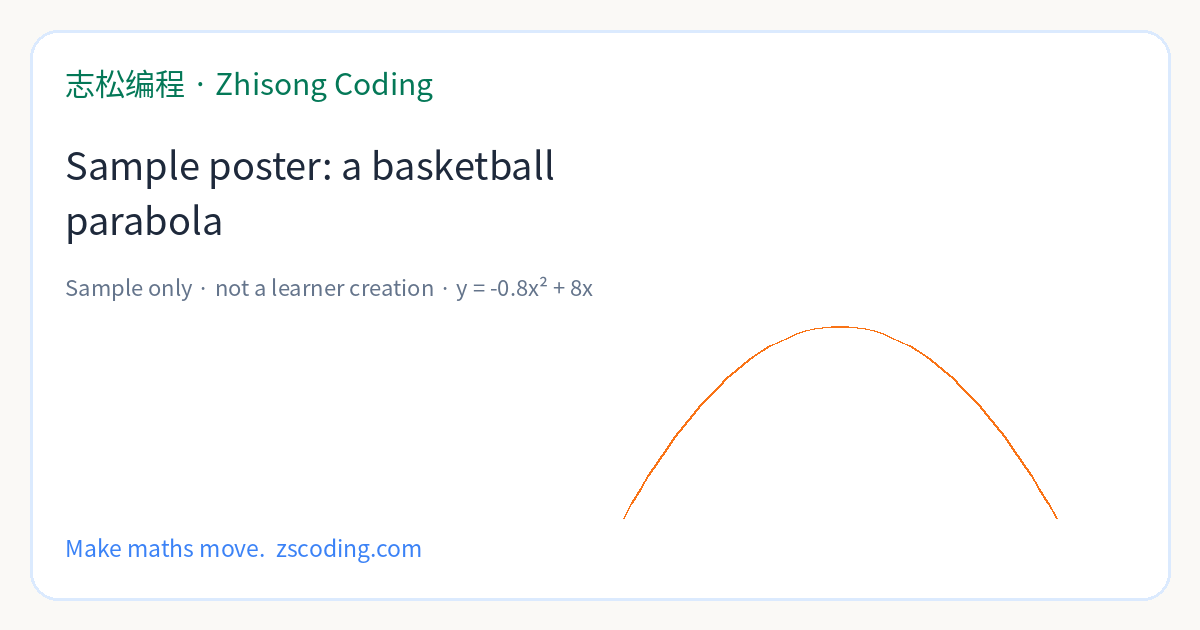
This sample was drawn by the platform’s poster maker; it is not a learner’s creation. After a child finishes a creation in the learning app and a guardian makes it public, the creations wall can make a poster with a QR code.
Make a poster on the creations wall ↗Try a lesson before choosing a course. These are demonstration plans in the development preview.
PayNow / Stripe / WeChat Pay SG · Payment is subject to a confirmed course order.
These sample perspectives illustrate the prototype. Published parent testimonials require verification and consent.
“Seeing the maths picture first gives my child confidence to try the code.”
Sample perspective · Nanyang Primary family“Comparing namespaces to family names and functions to juicers makes word cards easy to discuss.”
Sample perspective · Bilingual family“Create on the computer and review lessons on a phone. Learning finds its own rhythm.”
Sample perspective · Singapore familyBuild confidence with syntax close to maths. Revisit the same ideas to introduce types, semicolons and compilation. Maths creations connect each step.
Use a computer for coding and the drawing canvas. Use mobile devices for lessons, documents, word cards, check-ins and family progress. There is no need to type whole programs on a phone keyboard.
Start with everyday situations and one-star tasks. Some advanced challenges need prior concepts; a trial and tutor assessment help choose the right starting point.
Three hint levels encourage observation, smaller steps and local syntax checks. Lesson hints remain available without a model. Tutors guide the curriculum and review creations.